
Stock updates, price lists, orders sent to an ERP for invoicing and connections with logistics providers: an online store exchanges data with several tools. Before choosing a connector, you need to agree what should be transferred, who maintains the information and how to recognise a successful handover.
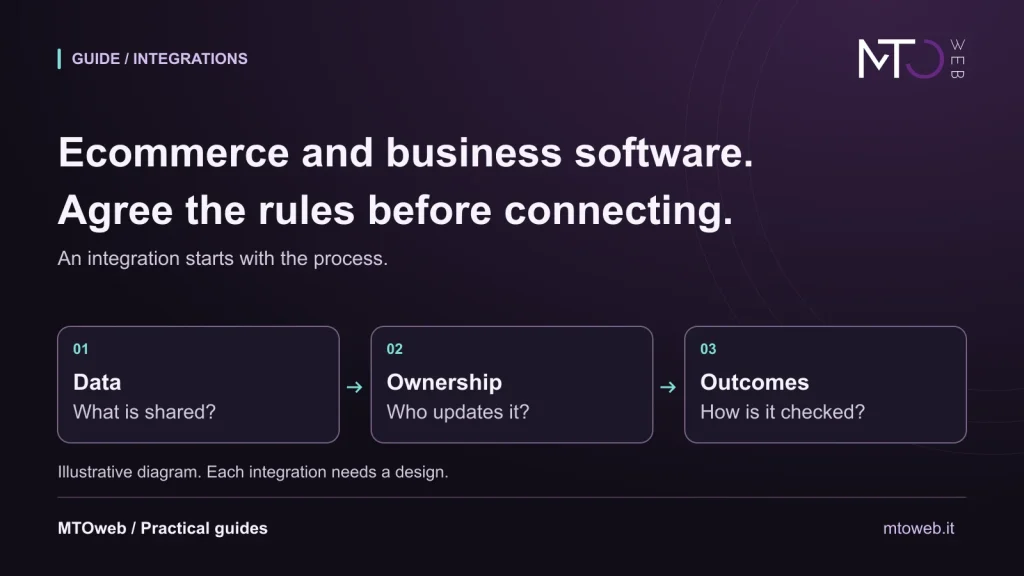
Illustrative MTOweb scenario, not a product or client screenshot.
Start with everyday operational flows
In the ecommerce integrations we work on, typical flows include stock and price-list updates, sending orders to an ERP for invoicing and integrations with logistics providers. These are related needs, but each requires its own rules: which data to exchange, in which direction and at what point.
Take sending an order to an ERP. You need to define when it is ready to be transferred, which information invoicing requires and how incomplete data should be handled. A logistics connection also needs a clear scope: preparing a shipment and receiving its status are different steps whose support must be checked in the systems involved. These examples help define that scope; they do not describe a particular client project.
Agree which system owns each piece of information
Every item of information needs an agreed source of truth. Business software might own product codes, price lists and availability, while the store owns sales descriptions and images. This is not a universal rule: it depends on the organisation. If both systems change the same field without a clear policy, an integration can overwrite a valid correction.
Details also matter: variants, units of measure, discontinued codes and the meaning of different statuses. A product appearing in two systems needs a reliable mapping. Resolve ambiguous cases using a sample of data before automating the transfer.
An API and a connector solve different parts of the problem
An API is an interface through which software exposes operations and information. For example, the PrestaShop Webservice documentation describes tools for accessing store data. Its documented resources help establish which information is available. The actual installation’s version, configuration and permissions still need to be checked.
A connector uses the systems’ interfaces and implements the integration rules: matching fields, translating statuses and recording outcomes. Having APIs on both sides does not mean the integration is ready. The required operations must be verified on each system, including the business application.
Update frequency follows operational needs
Periodic updates may suit some data, while other information needs a shorter delay. Consider the risk of selling against outdated availability, the volume of operations and the limits of the services involved. “Real time” needs an agreed operational meaning, rather than simply appearing as a label in a quotation.
Also define what happens while one system is unavailable: which work can continue, which transfers remain pending and how staff can see that the flow is incomplete. The need for manual checks depends on the process and the consequences of an error.
An interruption must not create a second order
Imagine the business system saves an order but its confirmation never reaches the connector. Before sending it again, the integration needs a way to recognise whether that order has already been received. A stable identifier and outcome checks help define this behaviour.
The technical principle of idempotency concerns the effect of repeated operations. HTTP specification RFC 9110 defines it for protocol methods. At application level, creating an order requires explicit rules to prevent duplicates. Simply repeating a request does not provide that guarantee.
Test cancellations and incomplete cases too
Before launch, test the ordinary journey alongside unknown products, missing variants, repeated submissions, cancellations and interrupted connections. Compare the expected and actual outcome for each case, and agree who should act. Logs should support diagnosis while limiting personal and confidential information.
To assess an integration, prepare the software names and versions, available documentation and a list of the manual handovers you want to address. Within our ecommerce service and custom software and integration development, the connection is defined around the systems involved. A clearly bounded first flow supports a concrete discussion of costs and testing, without promising a universal connector.